
INSIGHTS & GUIDES
Energy Goes Where Attention Flows: How I Used a 90-Day Vision to Change My Weight
A source-based article for careful, progressive study of the Master Key System.
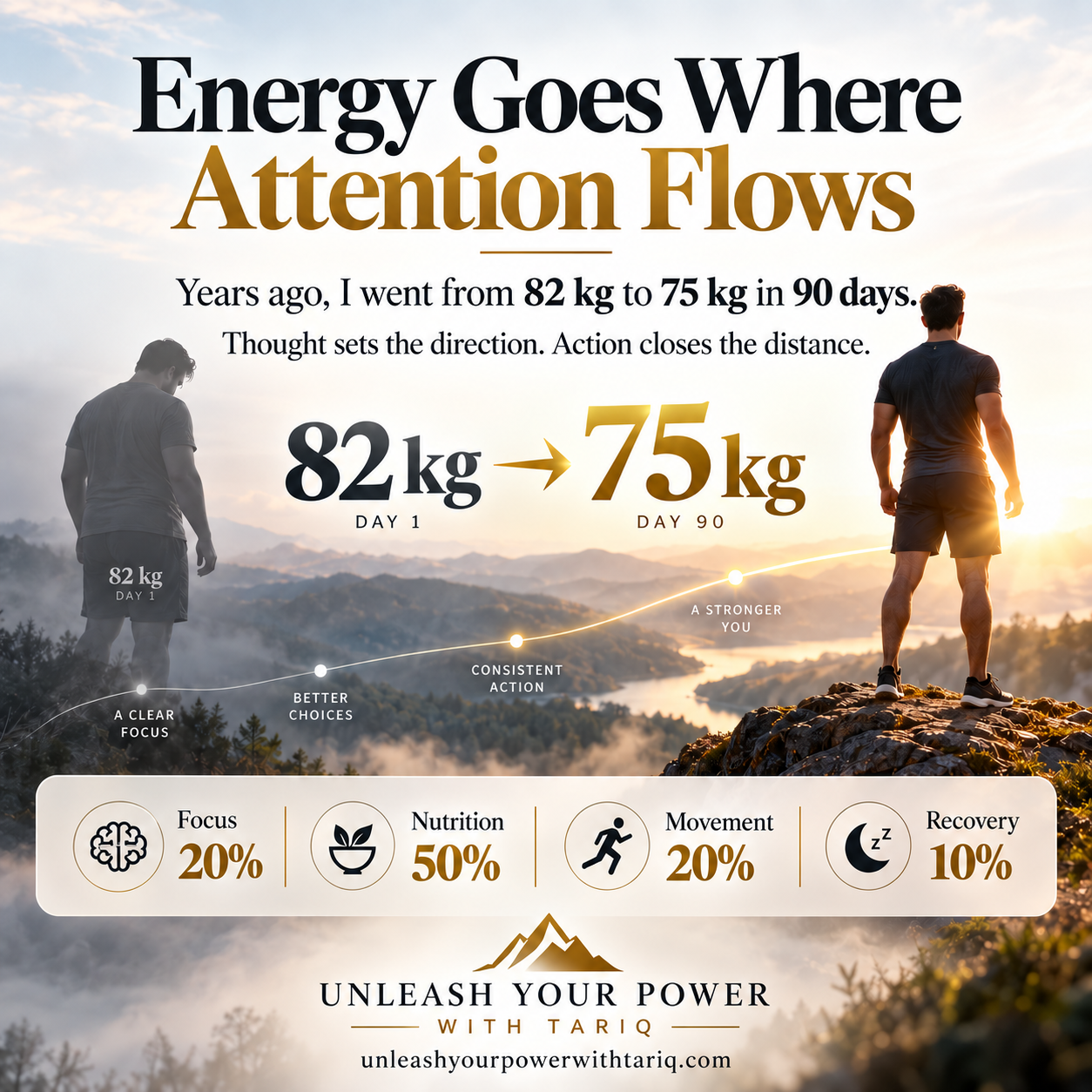
Years ago, I decided to test a simple idea on something I could actually measure: my weight.
I was 82 kg.
I decided I wanted to be 75 kg.
And I gave myself 90 days.
Instead of waking up every day thinking:
I need to lose weight.
I'm too heavy.
I shouldn't be eating this.
I changed what I was giving my attention to.
My focus became:
75 kg.
I visualised it.
I imagined seeing 75 kg on the scales.
I imagined how my clothes would fit.
I imagined feeling lighter.
I imagined having more energy.
Most importantly, I started thinking from the perspective of the person I wanted to become rather than constantly focusing on the condition I wanted to escape.
Over those 90 days:
82 kg became 75 kg.
That was a reduction of 7 kg — approximately 8.5% of my starting body weight.
But there is an important lesson here.
Visualization didn't physically remove seven kilograms from my body.
It helped give my behaviour a destination.
Thought Sets the Direction
This is where I believe one of the most practical lessons within Charles Haanel's The Master Key System becomes relevant.
What we repeatedly hold in our attention can influence what we notice, the decisions we make and the actions we repeatedly take.
When my attention was on 75 kg, my daily choices had a reference point.
Before eating something, consciously or subconsciously, there was now a question:
Does this take me towards 75 kg or away from it?
When I had an opportunity to move more, the same principle applied.
When I wanted to give up, the picture was still there.
The goal hadn't disappeared.
That is what I mean when I say:
Energy goes where attention flows.
Not that thought replaces action.
Thought directs action.
Visualization Is Not Magic
This distinction matters.
You cannot simply visualise yourself at your ideal weight while continuing indefinitely with habits that move you in the opposite direction and expect your body to somehow ignore them.
Your physical results still depend on your behaviour.
What you eat matters.
How much you move matters.
Sleep matters.
Recovery matters.
Consistency matters.
Health and individual circumstances matter too.
So I don't look at visualization as magic.
I look at it as mental direction.
You decide where you are going before you start walking.
My Simple 20–50–20–10 Framework
There isn't a scientific formula saying:
20% mindset. 50% nutrition. 20% exercise. 10% recovery.
I don't want anyone reading this to interpret those numbers as medical science.
Instead, I use them as a simple personal-development framework for understanding how the different pieces work together.
20% — Focus
This is where the journey begins.
What exactly do you want?
My answer wasn't:
I'd like to lose some weight.
It was:
75 kg.
Specific.
Measurable.
Visible.
When your target is vague, your actions can easily become vague too.
A clear destination gives you something against which you can evaluate your decisions.
50% — Nutrition
Then the mental picture has to meet reality.
For me, focusing on 75 kg made me more aware of what I was putting into my body.
That doesn't mean every meal had to be perfect.
It means there was greater awareness.
One poor food choice doesn't determine your future.
Neither does one healthy meal.
It is the pattern that matters.
The little choices repeated over weeks and months become significant.
And once you have a clear destination, those little decisions start carrying more meaning.
20% — Movement
Movement was another part of the process.
Walking.
Exercise.
Being active.
Using your body.
Again, the goal wasn't punishment.
It wasn't:
I've eaten something bad, so now I need to exercise.
The better mindset was:
I'm building the body and lifestyle that matches the picture I'm holding in my mind.
That is a completely different relationship with exercise.
10% — Recovery
Then there is the part that can easily be overlooked.
Sleep.
Rest.
Stress.
Recovery.
And perhaps most importantly:
Consistency.
The goal isn't to behave perfectly for three days and then abandon everything.
The real power comes from doing enough of the right things for long enough that change has a chance to accumulate.
Think About What Happens Over 90 Days
Imagine two people beginning at exactly the same weight.
The first person repeatedly thinks:
I'm overweight.
Losing weight is difficult.
Nothing seems to work.
I'll probably fail again.
The second person establishes a very clear picture:
This is where I'm going.
And each morning asks:
What would that version of me do today?
They may begin making slightly different decisions.
Take the stairs.
Walk another twenty minutes.
Choose a different lunch.
Drink water.
Stop eating when satisfied.
Exercise instead of skipping it.
Go to bed a little earlier.
None of those decisions on their own looks life-changing.
Now multiply them across:
90 days.
That's where it becomes interesting.
Your Inner Picture Can Influence Your Outer Behaviour
This, for me, is one of the most valuable ways to interpret the Master Key System.
Your inner world doesn't replace your outer actions.
It can help organise them.
First comes the thought.
Then attention.
Then repeated decisions.
Then repeated actions.
Then results.
Visualization kept the destination in front of me. My actions did the travelling.
I like to summarise it this way:
Thought sets the direction.
Attention keeps the destination visible.
Action closes the distance.
The mistake is stopping after the first step.
Thinking without acting gives you a dream.
Acting without direction can leave you running in circles.
But when clear thought and consistent action begin working together, you have something much more powerful.
Try Your Own 90-Day Experiment
You don't have to use weight.
Choose something measurable in your own life.
It could be:
Your fitness.
Your income.
Your career.
Your confidence.
Your business.
Your knowledge.
Your relationships.
Your personal development.
Start with three things:
Where am I now?
Where do I want to be in 90 days?
What would the person who achieves that result do differently today?
Then create the picture.
Spend a few minutes every day seeing the result as clearly as you can.
Not merely wishing for it.
Experience it mentally.
See it.
Feel it.
Then get up and do something that is consistent with it.
One Action Every Day
This is where visualization becomes practical.
After you finish visualising, ask:
What is one action I can take today that moves me towards that picture?
Then do it.
Tomorrow, repeat the process.
The next day, repeat it again.
Your life usually doesn't transform because of one enormous decision.
It transforms through hundreds of smaller decisions that begin pointing in the same direction.
What 82 kg to 75 kg Taught Me
My biggest lesson from those 90 days wasn't simply losing seven kilograms.
It was discovering what happened when I stopped concentrating on the problem and started concentrating on a clearly defined result.
82 kg was my starting point.
75 kg became the destination.
Visualization kept the destination in front of me.
My actions did the travelling.
And that principle extends far beyond weight.
What are you repeatedly giving your attention to?
Your problems?
Your fears?
Your limitations?
Or the life you are actually trying to create?
Because whatever goal you choose, remember:
Thought sets the direction.
Attention keeps the destination visible.
Action closes the distance.
And that is when:
Energy Goes Where Attention Flows.
Continue the conversation
If you want to discuss your goals and whether the 24-week programme is right for you, book a call with Tariq.
START YOUR 7 DAYS Explore Foundation BOOK YOUR CALL Download PDF
Health note: This article describes my personal experience and a personal-development framework, not medical advice or a prescribed weight-loss formula. Body weight can be affected by nutrition, physical activity, sleep, health conditions, medications and other individual factors. Seek appropriate professional healthcare guidance before making significant diet or exercise changes where necessary.